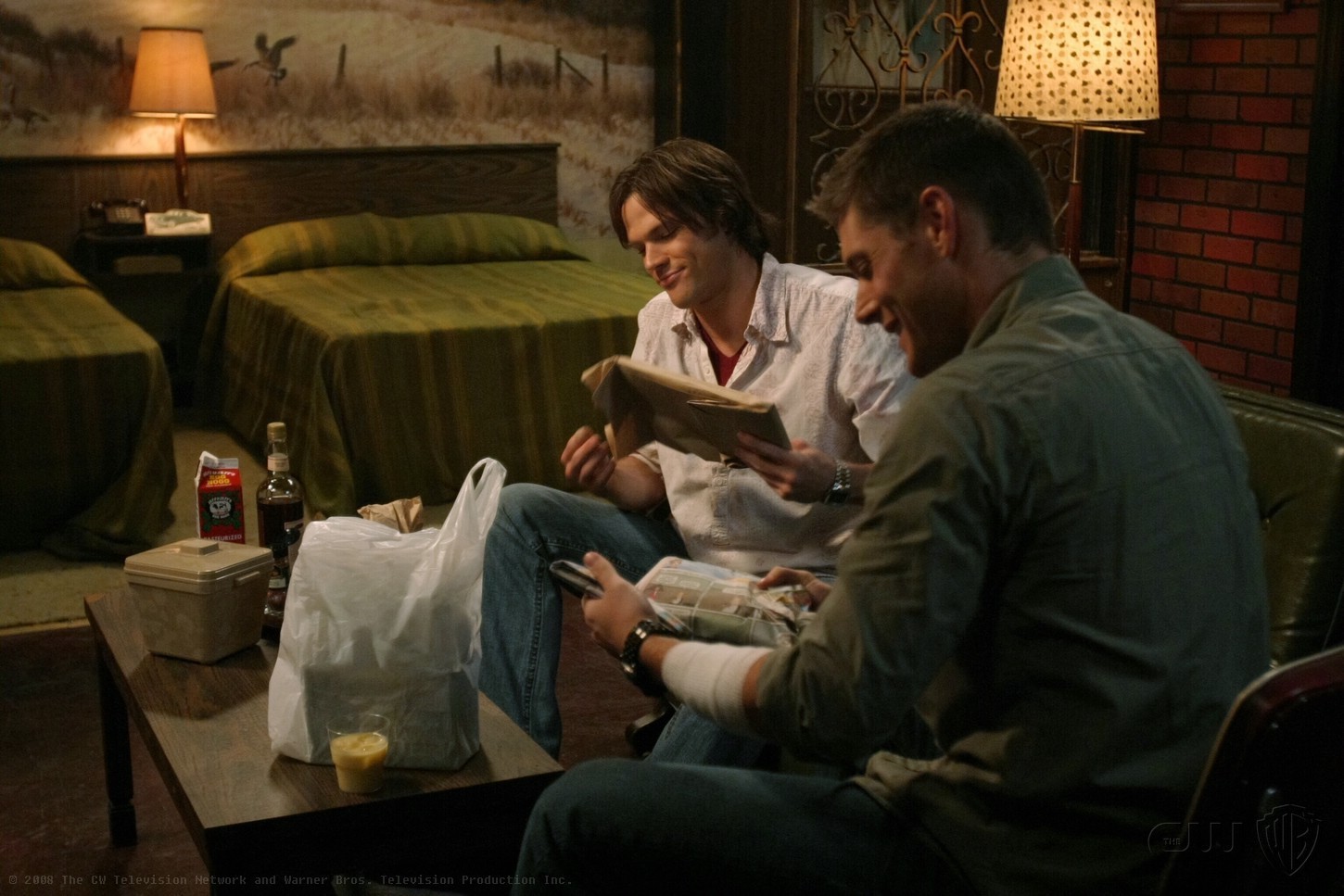
 Sam (Jared Padalecki) and Dean (Jensen Ackles) Winchester are monster-hunting brothers. After their mother was killed when Sam was six months old and Dean was four years old, they and their father, John, have been living on the road and killing evil as they go.
Set in season three, “A Very Supernatural Christmas” follows the boys as they investigate a case involving evergreen stakes, peanut brittle and...evil Santa?
It’s Christmas Eve and little Stevie can’t wait until Santa comes to bring him presents. Though he doesn’t know it, his grandfather has decided to make it a Christmas to remember and dressed up as the big man himself to treat his grandson. After jingling a bell to alert Stevie to “Santa’s” arrival, Grandpa carefully places gifts under the tree. Thumps on the roof and soot falling from the chimney excite Stevie and confuse Grandpa. As he investigates, Grandpa is grabbed and dragged, kicking and screaming, up the chimney, leaving only a bloody boot behind.
A year later, a similar disappearance brings Sam and Dean to Ypsilanti, Michigan. They begin to investigate the possibilities, searching through lore on everything from evil chimney sweeps to, as Dean puts it, “Santa’s shady brother.” As the brothers learn of two more disappearances, the ‘evil Santa’ theory seems less likely and they begin to suspect something, or someone, more powerful is involved.
“A Very Supernatural Christmas” is marvelous in its exploration of Christmas mythology, but the highlight is the glimpse it gives of Sam and Dean as children. Several flashbacks to a 12-year-old Dean (Ridge Canipe) and eight-year-old Sam (Colin Ford) reveal just how much the boys mean to each other and what a childhood in the Winchester family was like.
Whether by ruining Christmas wreaths forever or by creating a deeper appreciation for the warm and safe holiday celebrations most enjoy, “A Very Supernatural Christmas” will leave viewers seeing Christmas, and the Winchesters, in a new light.
Sam (Jared Padalecki) and Dean (Jensen Ackles) Winchester are monster-hunting brothers. After their mother was killed when Sam was six months old and Dean was four years old, they and their father, John, have been living on the road and killing evil as they go.
Set in season three, “A Very Supernatural Christmas” follows the boys as they investigate a case involving evergreen stakes, peanut brittle and...evil Santa?
It’s Christmas Eve and little Stevie can’t wait until Santa comes to bring him presents. Though he doesn’t know it, his grandfather has decided to make it a Christmas to remember and dressed up as the big man himself to treat his grandson. After jingling a bell to alert Stevie to “Santa’s” arrival, Grandpa carefully places gifts under the tree. Thumps on the roof and soot falling from the chimney excite Stevie and confuse Grandpa. As he investigates, Grandpa is grabbed and dragged, kicking and screaming, up the chimney, leaving only a bloody boot behind.
A year later, a similar disappearance brings Sam and Dean to Ypsilanti, Michigan. They begin to investigate the possibilities, searching through lore on everything from evil chimney sweeps to, as Dean puts it, “Santa’s shady brother.” As the brothers learn of two more disappearances, the ‘evil Santa’ theory seems less likely and they begin to suspect something, or someone, more powerful is involved.
“A Very Supernatural Christmas” is marvelous in its exploration of Christmas mythology, but the highlight is the glimpse it gives of Sam and Dean as children. Several flashbacks to a 12-year-old Dean (Ridge Canipe) and eight-year-old Sam (Colin Ford) reveal just how much the boys mean to each other and what a childhood in the Winchester family was like.
Whether by ruining Christmas wreaths forever or by creating a deeper appreciation for the warm and safe holiday celebrations most enjoy, “A Very Supernatural Christmas” will leave viewers seeing Christmas, and the Winchesters, in a new light.Friday, December 26, 2014
Supernatural: A Very Supernatural Christmas
Sam (Jared Padalecki) and Dean (Jensen Ackles) Winchester are monster-hunting brothers. After their mother was killed when Sam was six months old and Dean was four years old, they and their father, John, have been living on the road and killing evil as they go.
Set in season three, “A Very Supernatural Christmas” follows the boys as they investigate a case involving evergreen stakes, peanut brittle and...evil Santa?
It’s Christmas Eve and little Stevie can’t wait until Santa comes to bring him presents. Though he doesn’t know it, his grandfather has decided to make it a Christmas to remember and dressed up as the big man himself to treat his grandson. After jingling a bell to alert Stevie to “Santa’s” arrival, Grandpa carefully places gifts under the tree. Thumps on the roof and soot falling from the chimney excite Stevie and confuse Grandpa. As he investigates, Grandpa is grabbed and dragged, kicking and screaming, up the chimney, leaving only a bloody boot behind.
A year later, a similar disappearance brings Sam and Dean to Ypsilanti, Michigan. They begin to investigate the possibilities, searching through lore on everything from evil chimney sweeps to, as Dean puts it, “Santa’s shady brother.” As the brothers learn of two more disappearances, the ‘evil Santa’ theory seems less likely and they begin to suspect something, or someone, more powerful is involved.
“A Very Supernatural Christmas” is marvelous in its exploration of Christmas mythology, but the highlight is the glimpse it gives of Sam and Dean as children. Several flashbacks to a 12-year-old Dean (Ridge Canipe) and eight-year-old Sam (Colin Ford) reveal just how much the boys mean to each other and what a childhood in the Winchester family was like.
Whether by ruining Christmas wreaths forever or by creating a deeper appreciation for the warm and safe holiday celebrations most enjoy, “A Very Supernatural Christmas” will leave viewers seeing Christmas, and the Winchesters, in a new light.
Thursday, December 18, 2014
Doctor Who: The Christmas Invasion

Monday, December 8, 2014
The Maze Runner
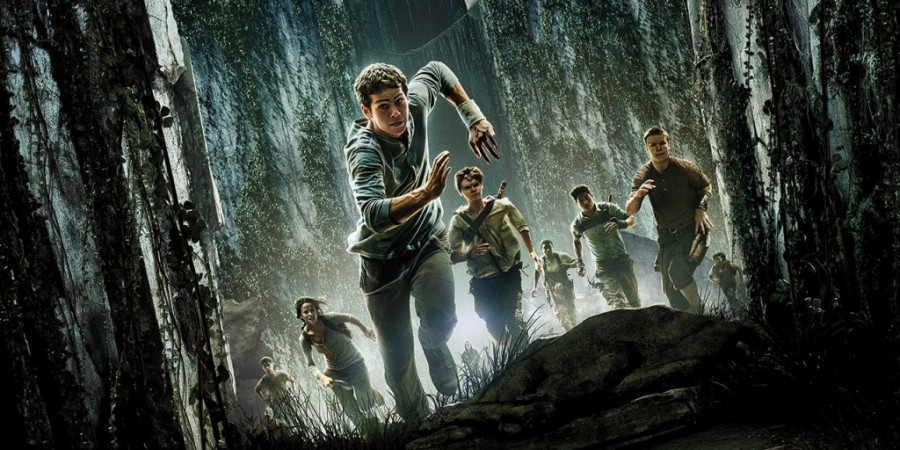
The box opens upon reaching the top of the shaft and Thomas (Dylan O’Brien) is introduced to his new home called the Glade, a camp of sorts, inhabited by a group of teenage boys.
Thomas soon learns that all of the boys arrive at the Glade in the same way, once a month, every month, for the last three years. In that time, they’ve made the Glade their home. They have buildings, gardens, leaders, jobs and three basic rules.
Do your part. Never harm another Glader. And never go into the Maze.
The Maze, as Thomas learns, surrounds the Glade. It’s filled with monsters, Grievers, which are heard but go unseen, and has walls that shift and change every night. The walls around the Glade close tightly at sunset. But beware the one who gets stuck on the outside when night falls.
As Thomas begins to acclimate to his new home, he starts asking questions and pushing the status quo. He remembers his name within a few hours of arriving and the snatches of memories in his dreams hint at something bigger going on.
Then, everything starts changing.
Based on the first book in a dystopian trilogy by James Dashner, “The Maze Runner” is a look at the resilience of teenagers and children in the face of hard circumstances—circumstances not chosen and certainly not asked for.
Much like “The Hunger Games” and “Divergent,” the movie begins to explore the limits of human morality when faced with the endangerment of the human race. Just how far is too far?
During the film, the audience learns with Thomas, who is forced to discover the secrets of the Glade and the Maze, without any outside knowledge or additional perspectives from other characters. Although this tends to slow the pace of the movie at some points, the story is punctuated with fast-paced scenes through the Maze. These pulse-quickening chases are further helped by a fantastic soundtrack, written by John Paesano.
The cinematography is beautiful, enhanced by a lovely Louisiana setting, and the graphics are realistic. The Maze is skin-crawlingly creepy and the Grievers’ presence is nothing to desire. The acting, while a bit rough in the beginning, is believable and doesn’t distract from the plot. The characterization, especially for those who have read the book, is spot on.
Several themes run through the movie, including that of resisting limits and pushing change, even when everyone else is happy to exist in comfortable boundaries. Thomas continually asks questions and breaks rules, something none of the others have done, with considerable consequences.
Additionally, the movie stresses the importance of sticking together, the only thing the characters can do to stay alive in their circumstances, and staying true to who one is. As Thomas realizes, it doesn’t matter who anyone was before the Maze. That person is lost and it’s what they do now that matters.
As the first part of a trilogy, “The Maze Runner” mainly sets up the rest of the story. Thus, most of the action, except for the scenes in the Maze, is saved for the end. But what an end it is.
It’s no “Hunger Games,” but “The Maze Runner” had enough action and suspense to stay entertaining. The story promised by the ending is especially exciting, and it will be interesting to see what the sequels will hold. At the very least, it will encourage viewers to read the books — and is that ever a bad thing?
Monday, April 21, 2014
Supernatural: What Is and What Should Never Be

“Supernatural” is a show about two brothers, Sam (Jared Padalecki) and Dean (Jensen Ackles) Winchester, who hunt the monsters, such as ghosts, ghouls, demons and other supernatural baddies, that haunt the night. “What Is and What Should Never Be” is the 20th episode of the second season, the last episode before the two-part season finale. Created by Eric Kripke, “Supernatural” first aired in 2005 and is now in its ninth season. The show was confirmed for a tenth season in January 2014.
When Mary Winchester (Samantha Smith) was killed by the Yellow-Eyed Demon, her sons’ lives changed forever. Any dreams of normalcy — college, friends, even a home — were consumed by her husband John’s single-minded pursuit of the demon that killed his wife.
Even now, months after their father’s death, Sam and Dean continue in the life he raised them in, hunting and killing evil before it can take anymore lives.
Saving people, hunting things — the family business.
So, what would happen if Mary never died? What would life look like if the Winchesters grew up in suburbia, living a normal, apple-pie life?
And what if Dean was the only one who could remember their lives as hunters?
When Dean goes alone to hunt a djinn, a genie from Islamic mythology, he is attacked and wakes up in a brand new world with a burning question:
Could the djinn grant a wish hidden so deep within him that he didn’t even know he was wishing it?
Unwilling to threaten the change by digging too deep, Dean settles into his new world. He has a job working on his beloved cars at the garage, a beautiful girlfriend and, for the first time in 23 years, his family is happy.
But soon this world begins to fall apart, creating questions he can’t ignore. Who is the girl he keeps seeing? Why doesn’t Sam seem to like him? And what is the cost of this new life?
Dean has been a hunter since he was four years old and only recently have the burdens and costs of the hunting lifestyle begun to weigh on him. As he struggles with his father’s death and John’s final order (You have to save Sam or kill him, Dean), he’s been finding it harder to hold on to the reasons behind the hunt.
And, faced with the possibility of a safe life, where happiness is more than a dream, Dean has to ask himself what his old life is worth.
“What Is and What Should Never Be” reveals a completely new aspect of Dean’s character, one that even he barely acknowledged until the djinn unveiled it. As Dean struggles with his heavy decision, viewers are reminded of the reasons they fell in love with this self-sacrificing, fiercely loyal character.
This episode has many of the beloved elements that characterize the show and its characters. From humor (as Dean attempts to convince those around him that really, he hasn’t been drinking) to supernaturally-tinged mystery (how did he get here and how does he get back?), this is one of the show’s most powerful episodes. Jensen Ackles (Dean) gives us a strong performance that reminds us of the softer side that his character hides beneath his tough, smart-aleck facade. One of the strongest moments of the episode is Dean’s heartfelt conversation with his dad as he tries to hold on to the fairy tale he’s been given.
"Why is it my job to save these people?” he asks. “Why do I have to be some kind of hero? What about us, huh? What, Mom’s not supposed to live her life, Sammy’s not supposed to get married? Why do we have to sacrifice everything, Dad?"
Classic songs set to the perfect scenes (such as when Joey Ramone’s “What A Wonderful World” plays as Dean begins settling into his new world and mows his mother’s lawn for the first time in a hilarious fashion) continue to be a fan-favorite.
This is the first episode that focused on only one of the boys, but the new dynamic never felt off-balance or lacking. And really, it was nice to see Dean be the damsel.
***As you've probably noticed, this review is quite different than the others. In a recent class, I was required to write a review and decided to use the opportunity to tackle a new medium, television, with my favorite show, "Supernatural." I plan to continue reviewing "Supernatural" and other TV show episodes, but I haven't yet decided what format these reviews will take. None will be as in-depth as this one, for sure, but we shall see what form they take. Thanks for reading!***
Wednesday, March 19, 2014
Black
 Summary
Fleeing assailants through deserted alleyways, Thomas Hunter narrowly escapes to the roof of a building. Then a silent bullet from the night clips his head . . . and his world goes black.
From the blackness comes an amazing reality of another world where evil is contained. A world where Thomas Hunter is in love with a beautiful woman.
But then he remembers the dream of being chased through an alleyway as he reaches to touch the blood on his head. Where does the dream end and reality begin?
Every time he falls asleep in one world, he awakes in the other. Yet in both, catastrophic disaster awaits him . . . may even be caused by him.
Some say the world hangs in the balance of every choice we make. Now the fate of two worlds hangs in the balance of one man's choices.
Afterthoughts
Have you ever wondered about other dimensions or parallel universes? This book, and the rest of the Circle series, explores the possibility of another world that is every bit as real as ours. Unfortunately, to Thomas, this truth is hard to grasp when he is the one bouncing between the two.
Yet, though this aspect of the story is a fixating hook, it will barely prepare you for this book's power.
The entire series is a wonderfully written, intriguing and stunning metaphor for the biblical story of redemption through creation, the fall, the crucifixion, the resurrection and God's continued wooing of His people. By taking insubstantial forces, such as good and evil, and making them physical in the parallel universe, Dekker makes abstract ideas easily understandable.
The truth woven into these metaphors will leave you reeling.
And, intermixed with this incredible 'otherworld story' is a fight to save this world from utter destruction. I have read this series countless times over the past 8 years, including last summer, and it astounds me every time. If you have time, go get it and read it. You will not be disappointed. I guarantee it.
Warnings
None.
Extras
Dekker's Facebook page.
Not really an extra (more of a cool fact), but one neat thing about the Circle series is that the four books literally go full circle. I don't want to give it away, but it is a really awesome technique. So, just if you needed extra incentive...
Subscribe to:
Posts (Atom)